Microwave repair in The Colony, TX
A microwave that hums but won't heat, sparks inside, or has a turntable that won't turn is usually a specific part failing, not the whole unit. Our technicians pinpoint the exact cause and repair it safely, since microwaves carry high-voltage components that shouldn't be opened without training.
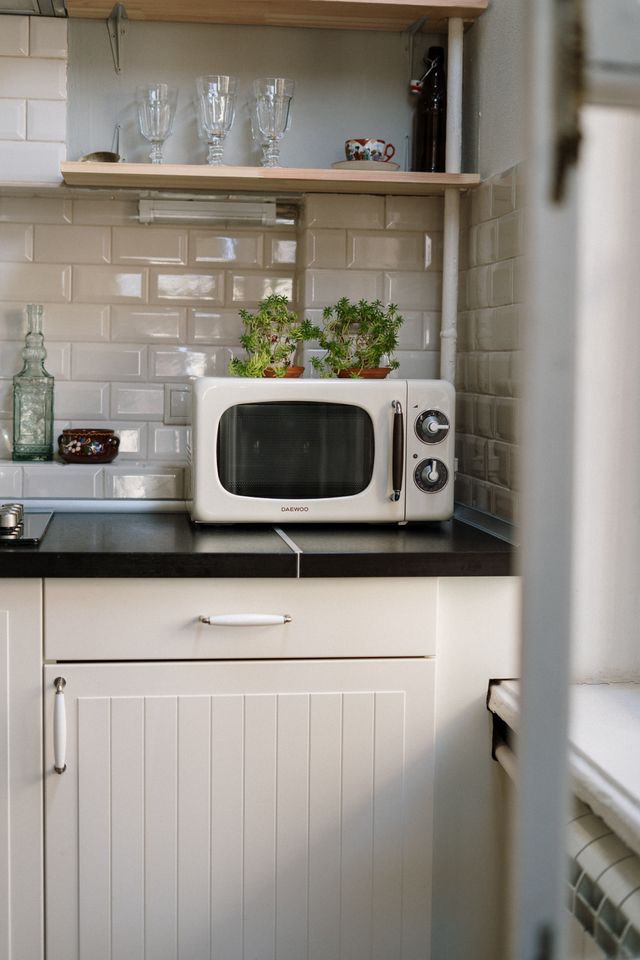
Signs your microwave needs a repair
Here's what usually tells us a microwave needs a technician rather than a quick reset.
Runs but doesn't heat
The unit hums and the light turns on, but food stays cold — usually the magnetron, diode, or capacitor.
Sparking or arcing inside
Often caused by metal left inside, but can also point to a damaged waveguide cover or faulty diode.
Turntable won't spin
A worn motor or a broken roller guide is usually behind a tray that stays still.
Buttons unresponsive
A worn touch panel or a control board issue can leave some or all buttons dead.
Loud humming or buzzing
More noise than usual during operation can point to the diode, magnetron, or the internal fan.
Runs with the door open
A dangerous door switch failure — stop using it immediately and call us right away.
Common causes and what repairs typically cost
Here's what usually causes each microwave problem we see in The Colony, and the typical price range once your technician confirms the exact issue.
| Likely cause | What it means | Typical repair cost* |
|---|---|---|
| Faulty door switch | A safety component that must engage correctly before the unit will run. | $50 – $100 |
| Damaged diode or waveguide cover | Common cause of sparking once metal objects are ruled out. | $50 – $125 |
| Worn turntable motor or roller guide | Drives the rotating tray that spreads heat evenly. | $75 – $150 |
| Failing touch panel or control board | Manages button input and the unit's settings. | $80 – $300 |
| Faulty magnetron | Generates the microwave energy that heats your food — the most expensive part. | $150 – $450 |
*Ranges reflect typical parts-and-labor costs across the industry. Your technician confirms the exact price on-site before starting any repair.
Sparking or running with the door open? Stop and unplug it
Microwaves store high-voltage energy even when unplugged, which is why we don't recommend opening the case yourself. If you see sparks, first check for metal or foil inside — if that isn't the cause, turn it off and call a technician rather than continuing to use it.
- Check for metal, foil, or metallic-trim dishware first
- If sparking continues with nothing metal inside, unplug it
- A unit that runs with the door open should never be used again
- Leave internal repairs to a trained technician
How we repair your microwave
Here's what happens from your first call to a working microwave again.
Inspect & diagnose
We check the door switch, diode, turntable motor, and magnetron to find the actual cause.
Quote before we start
You get a flat-rate price for the repair before any parts are touched.
Repair safely
High-voltage components are discharged and handled correctly by a trained technician.
Test heating & rotation
We confirm the unit heats evenly and the turntable spins before we call it done.
Brands we repair
We regularly service Whirlpool, Samsung, LG, GE, and KitchenAid microwaves found throughout The Colony, including built-in and over-the-range models.
Related services
Over-the-range microwaves sometimes share ventilation issues with range hoods.
View all servicesMicrowave repair questions
What homeowners in The Colony most often ask before booking a microwave repair.
Why is my microwave not heating?+
This is usually a failed magnetron, diode, or capacitor. A blown door switch can cause similar symptoms since it can prevent the unit from running properly even though the display still works.
Is it safe to keep using a microwave that sparks?+
First check for metal or foil inside, since that's the most common cause. If sparking continues with nothing metal in the unit, stop using it and have a technician inspect the diode and waveguide cover.
How much does microwave repair cost?+
Most repairs run between $50 and $450 depending on the part, plus the standard $60–$95 service call fee. Simple fixes like a door switch are on the lower end.
Why does my microwave hum loudly?+
Some hum is normal during operation, but a loud or irregular hum can point to an issue with the diode, magnetron, or the internal cooling fan.
Is it worth repairing an older microwave, or better to replace it?+
Microwaves typically last 8 to 10 years. For a countertop model under $300 new, a repair over about $150 usually isn't worth it. Built-in and over-the-range models are almost always worth repairing since replacement involves more than swapping a box.
Why won't my turntable spin?+
A worn turntable motor or a cracked roller guide are the most common causes. It's not dangerous to use the microwave in the meantime, but food will heat unevenly with hot and cold spots.
Microwave not heating or sparking? Let's fix that today.
Call now for a same-day or next-day appointment with a local technician.